A Wyckoff Consulting Thought Paper
There is a dangerous moment in the life of a successful company.
Nothing appears to be terribly wrong.
Customers are still buying. Employees are busy. Revenue is coming in. The company may even be profitable.
But the numbers tell a different story.
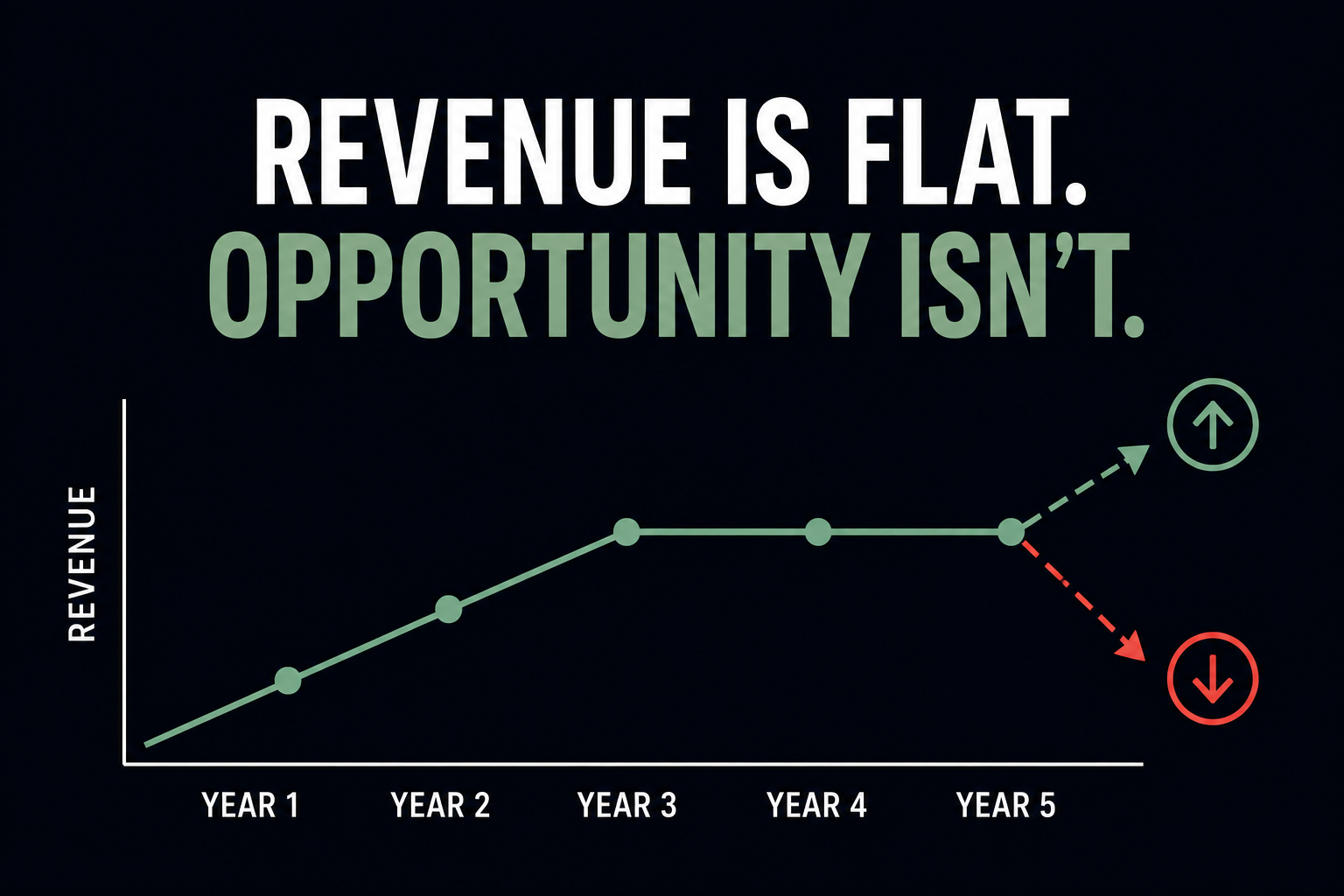
Growth has stopped.
Maybe revenue grew 15% three years ago, 8% two years ago, 3% last year—and this year looks remarkably similar to the year before.
The organization isn’t failing.
It’s stalled.
For owners and CEOs of established $3 million to $50 million companies, this can be one of the most difficult business problems to recognize and address.
Why?
Because the company still looks successful.
And that makes stalled growth incredibly easy to tolerate.
Until it isn’t.
Competitors continue investing. Customer expectations change. Great employees want opportunities. Costs increase. Margins tighten. The pipeline becomes less predictable.
Eventually, standing still starts looking a lot like falling behind.
After more than three decades working across industries, I have found that growth rarely stalls because of one catastrophic decision.
More often, companies simply outgrow the strategies that made them successful.
Here are three places I would look first.
1. The Strategy That Got You Here Won’t Get You There
Most successful companies have a growth formula.
Sometimes it’s a great salesperson.
Sometimes it’s the founder’s relationships.
Sometimes it’s referrals.
Sometimes it’s one major customer, one market, one product, or one channel.
And for years, it works.
So the company keeps doing it.
That’s completely rational—until the formula reaches its natural ceiling.
The problem is that leadership teams often respond to slowing growth by simply asking everyone to do more of what worked before.
- Make more calls.
- Attend more trade shows.
- Spend more on advertising.
- Post more content.
- Hire another salesperson.
The activity increases, but the trajectory doesn’t.
That’s because more activity isn’t necessarily a growth strategy.
When a $5 million company wants to become a $10 million company—or a $25 million company wants to become a $50 million company—the question shouldn’t be:
“How do we do more?”
The question should be:
“What must be different?”
- Different customers?
- Different markets?
- Different positioning?
- Different products?
- Different channels?
- Different capabilities?
- Different people?
Growth frequently begins again when leadership stops optimizing yesterday’s playbook and starts building tomorrow’s.
2. Sales Is Carrying a Job Marketing Should Be Doing
This is particularly common in founder-led and sales-driven organizations.
The company has talented salespeople, strong relationships, and a reputation built over many years.
But marketing never matured alongside the business.
Sales is expected to create awareness, generate interest, find prospects, educate buyers, differentiate the company, nurture relationships, and close business.
That’s an enormous burden.
Your best salespeople should be spending their time selling, not compensating for the absence of a marketing engine.
A mature growth organization creates leverage around sales.
Marketing should help the market understand:
- Who are you?
- Why are you different?
- Why should I trust you?
- Why should I talk to you?
- Why should I choose you?
Before the salesperson ever walks into the room.
When marketing and sales work independently—or marketing exists primarily as a collection of disconnected tactics—the company doesn’t have a growth engine.
It has activities.
And activities without strategy become expensive very quickly.
3. Nobody Owns Growth From the Executive Marketing Seat
This may be the most overlooked problem.
Ask the leadership team:
“Who owns marketing?”
The answers are often revealing.
- “The CEO.”
- “Our sales VP.”
- “We have someone who handles social media.”
- “Our agency does that.”
- “We all kind of do.”
Those answers may work at $3 million.
They become increasingly dangerous as the organization grows.
Someone needs to wake up thinking about the market.
- Where is demand changing?
- What are competitors doing?
- Which customers are most profitable?
- Where should the company expand?
- What should the company stop doing?
- How is the brand perceived?
- Where are leads coming from?
- What is converting?
- What isn’t?
- Where should the next marketing dollar go?
And most importantly:
What is the company’s next source of profitable growth?
That’s an executive responsibility.
Marketing isn’t simply websites, advertising, social media, trade shows, email, or lead generation.
At the executive level, marketing is about determining where the company should compete, how it should differentiate, whom it should pursue, and how it will create profitable demand.
If nobody owns those questions, eventually growth becomes accidental.
The Cost of Waiting
Here’s where stalled growth becomes dangerous.
Leadership teams often wait for the problem to become painful before addressing it.
But a growth plateau is a leading indicator.
By the time the organization experiences declining revenue, shrinking margins, salesperson turnover, customer concentration problems, or lost market share, the underlying issue may have existed for years.
That’s why I believe CEOs should treat a sustained growth plateau with the same seriousness they would treat a significant operational or financial variance.
Don’t normalize the plateau.
Investigate it.
Because the question isn’t simply:
“Why aren’t we growing?”
The more important question is:
“What happens to the value of this company if we don’t start growing again?”
For a privately held company, that can eventually become a very expensive question.
Three Questions Every CEO Should Ask
If your company’s growth has flattened, start here:
- If we continue doing exactly what we’re doing today, where will revenue be three years from now?
- Can we clearly identify the next significant source of profitable growth?
- Is there one executive accountable for building the strategy to get us there?
If the answers make you uncomfortable, that’s useful.
A plateau isn’t necessarily a crisis.
It’s a signal.
And the companies that respond to that signal early have far more options than the companies that wait until stalled growth becomes declining growth.
Growth Has Stalled. What Happens Next?
Wyckoff Consulting works with established companies generating $3 million to $50 million in annual revenue during critical business inflection points.
When growth stalls, our role as a Fractional Chief Marketing Officer is not to simply recommend more marketing.
We help leadership determine why growth has stalled, where the next opportunity exists, and what needs to change to capture it.
Because sometimes the biggest threat to a successful company isn’t failure.
It’s becoming comfortable with where you are.
Without margin, there is no mission.
— Luke Wyckoff
Founder, Wyckoff Consulting